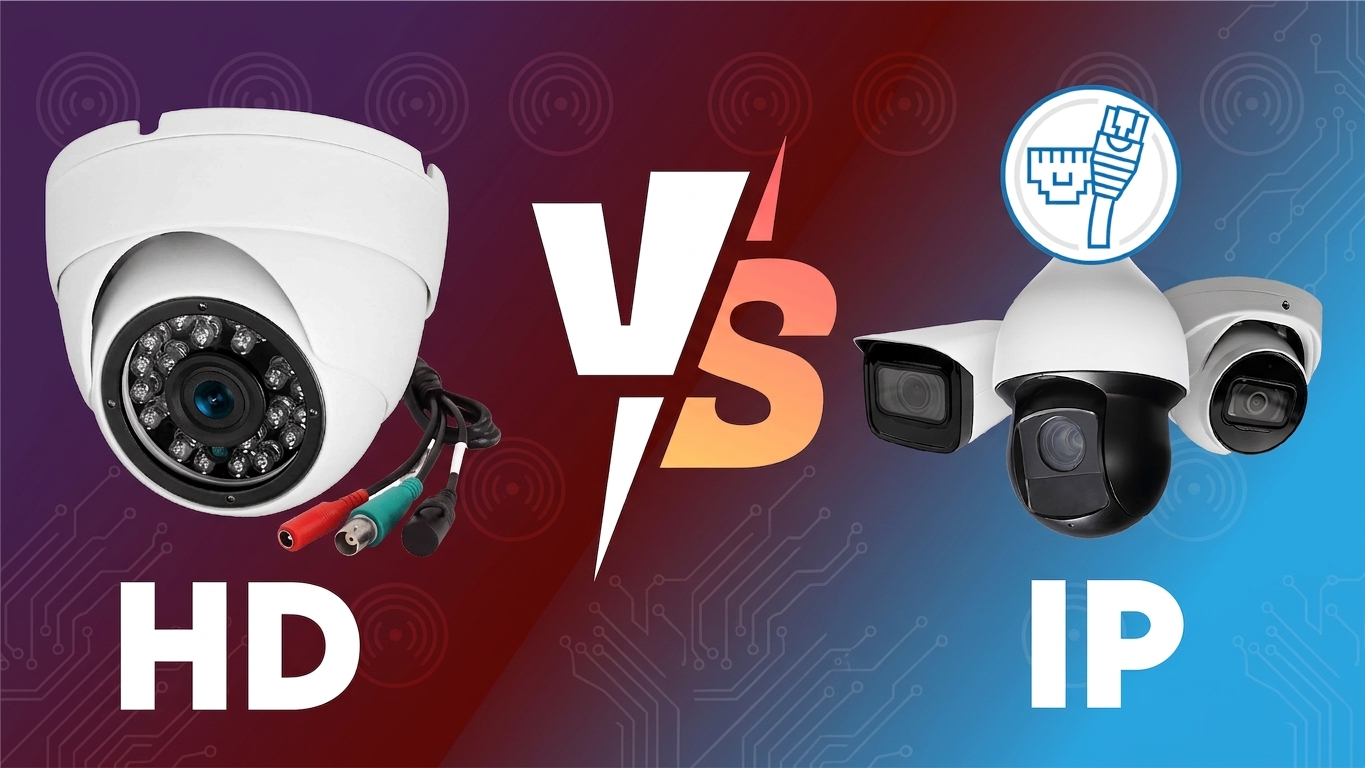
Analogue HD did not disappear when IP cameras arrived. Both are installed daily, and the right choice depends on the site rather than on which technology sounds more modern.
Analogue HD
Analogue HD systems send video over coaxial cable to a DVR. They are straightforward, economical, and particularly attractive where coaxial cabling already exists — upgrading cameras and recorder while reusing the cable is a fraction of the cost of a rewire.
The trade-offs: resolution options are more limited at the top end, each camera generally needs its own cable run back to the recorder, and integration with other systems is more restricted.
IP
IP cameras run over network cabling to an NVR, usually drawing power over the same cable (PoE). That means one cable per camera for both power and video, higher available resolutions, easier expansion, and far better integration with access control and analytics.
The trade-offs: it is a network, so it needs to be designed like one — switching capacity, bandwidth and storage all have to be calculated rather than assumed. Equipment costs more per camera.
How to choose
- Existing coaxial cabling in good condition? Analogue HD is often the economical route.
- New building or a rewire anyway? Install network cabling; the flexibility is worth it.
- Need identification at distance or wide high-detail coverage? IP resolutions give you more to work with.
- Planning to add access control or analytics? IP integrates far more comfortably.
- Expecting to expand in phases? IP scales with less rework.
Mixed systems
Hybrid recorders accept both, which is often the practical answer for a site that is upgrading gradually: keep the working analogue cameras, add IP where new coverage is needed, and migrate over time rather than all at once.
Have a question about this? Ask our technical team on WhatsApp.
Chat on WhatsApp